
Most brands do not pick their Amazon model. An agency set it up in 2019, or Amazon extended an invitation to Vendor Central, and nobody has revisited the decision since. The default “set it and forget it” approach can be expensive. Your model decides who owns the inventory, who sets the price, who pays Amazon's fees, and what a buyer sees when your business goes up for sale.
Front Row runs three separate models designed to meet a brand where they are; we have no single model agenda to push. Below are the four questions that sort the decision out, drawn from conversations we have with brands every day. We also explain what hybrid actually means. Work through the questions in order and you will land on a model, or at least on better questions for your next partner call.
The three models, in plain language
Three models cover almost every Amazon setup, and the labels change depending on who you ask. Here is how the terms map.
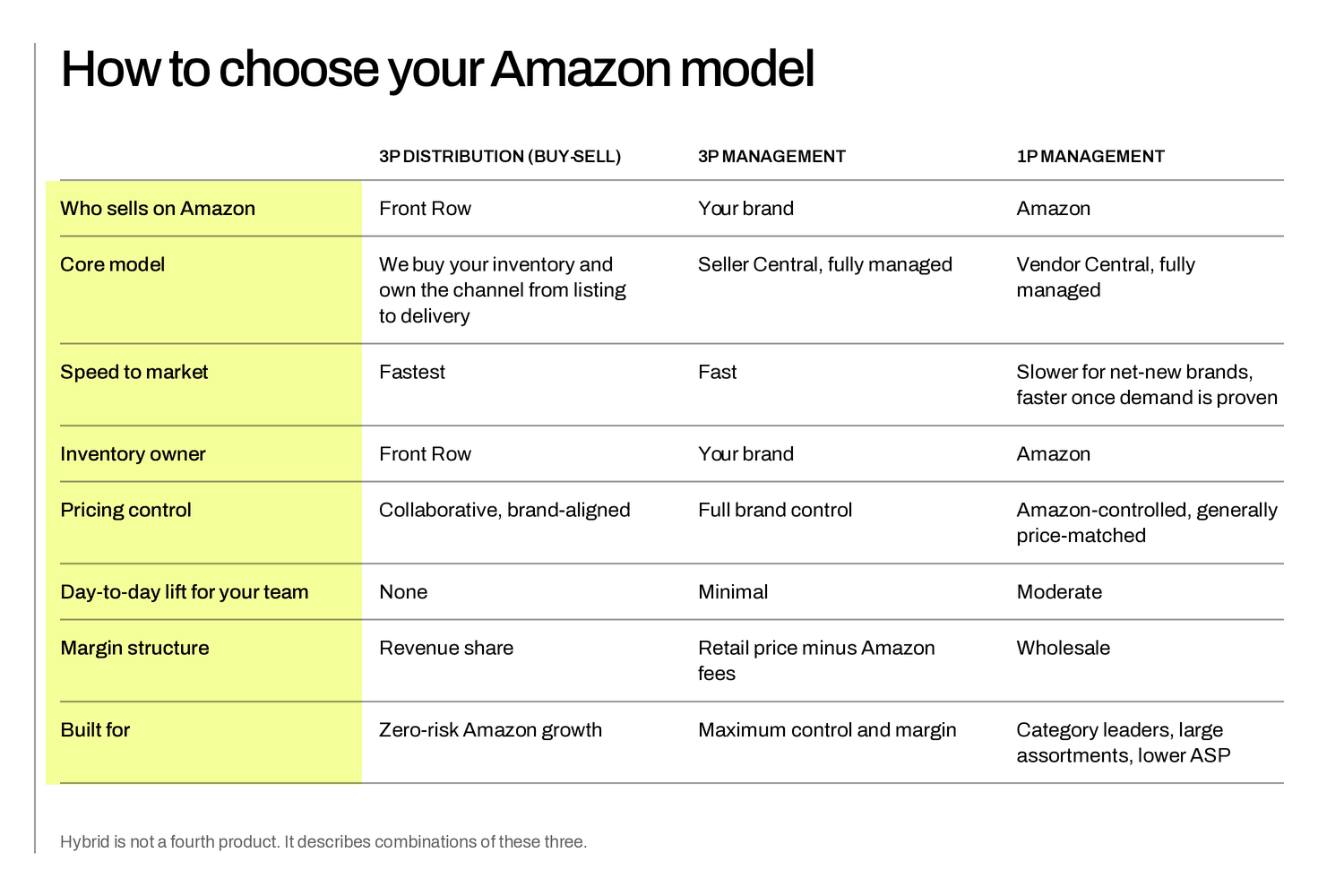
Buy-sell (our 3P Distribution). We buy your inventory and sell it on Amazon through our own seller account. We carry the inventory risk and cover Amazon's fees, which makes this the fastest route to market with almost no daily lift for your team.
Managed service, 3P (our 3P Management). You keep Seller Central and your inventory. We run strategy and execution, and our fee is a percentage of net sales.
Managed service, 1P (our 1P Management). Amazon buys from you wholesale through Vendor Central. We manage the relationship and optimize it to scale without giving up margin.
1. Who should own the inventory and the P&L?
Start with the money question: who carries the inventory, and who pays Amazon's fees.
In buy-sell distribution, we purchase the inventory up front, carry the risk, and cover all Amazon fees, returns and brand protection legal costs. Your cash stays out of stock and your finance team gets predictable purchase orders. The trade is a share of the margin and less direct control over day-to-day moves.
In 3P management, you own the inventory, cover the fees, and you keep the margin. We forecast, recommend strategy and execute.
In 1P management, Amazon buys the inventory, and your margin takes pressure from trade terms, co-op and chargebacks.
A simple read: if working capital is tight or inventory risk keeps your finance team up at night, buy-sell earns a close look. If you have the capital and want to keep the margin, managed service fits.
One operator acquiring a brand told us it leaned toward managed service for simplicity and fit with its own operating strengths. It also asked that our fee be calculated on net sales after promotions and advertising, so both sides win when the business does.
2. When is your next raise and/or exit?
If a sale or a raise sits within two years, your Amazon model becomes part of the story a buyer reads.
Buyers and investors look at how revenue flows, who holds the data, and what happens if a partnership ends. Buy-sell partnerships commonly run on multi-year terms, so that last question deserves an answer before you sign, not during diligence.
One consumer brand planning a sale within about a year, with price points in the $20s, ruled out buy-sell and settled on managed service. A PE-backed brand weighing a move from 1P to distribution brought a different list: business model risk against a steady 1P business, data access and ownership, exit scenarios, and a one-year first term instead of three.
Neither brand was wrong to ask. If an exit is on your horizon, put the buyer's questions to every partner now. Who owns the data? What does a clean separation look like? How long is the commitment?
3. How much of the operation do you want to keep?
Decide which parts of the account you refuse to hand over: pricing, content approval, ad strategy, customer data.
In 3P management you hold full control of pricing and brand, and your daily lift stays minimal because we run execution. In buy-sell, pricing is collaborative and brand-aligned, and your team's daily lift is close to none. That is real influence, but it differs from the full authority a Seller Central brand holds. In 1P, Amazon controls pricing and generally price-matches to the market.
Price point matters here too. The 1P model suits category leaders with large assortments and lower average selling prices, where wholesale scale outweighs the loss of price control.
One founder team launching its first online CPG line leaned toward managed service to keep control, partly because wholesale was the model it already understood. We offered to walk its wider group through the trade-offs, which is the right instinct for any decision this size.
4. What is broken first, strategy or enforcement?
Put the fire out before you design the garden: if resellers, lost Buy Box or suppressed listings are the emergency, your model has to hand your partner the keys.
Buy-sell consolidates selling under one authorized seller, which gives enforcement real teeth. Resellers get removed, pricing stabilizes, and Buy Box ownership follows. It also gives your partner direct escalation paths into Amazon when a listing goes dark.
If your Buy Box is healthy and the pain is flat growth, a partner needs strategy and execution, not control of the seller account. That points toward managed service, with no inventory change required.
One skincare brand came to us with a listing suppressed for more than a month, Buy Box lost on two products within days of each other, resellers undercutting price, and an agency exit that would not come clean. It chose buy-sell. We took Amazon's fees onto our side of the ledger and funded media from net sales, so the brand could stop firefighting and start growing.
Hybrid, honestly, and the 1P question
In practice, hybrid means one of two things, and it helps to know which one you are asking for.
Start managed, keep buy-sell open. Some brands begin as a managed service and agree up front that moving to buy-sell stays available later. That lowers the cost of a wrong first guess. It also lightens the starting paperwork: managed service needs your Amazon selling price, while buy-sell pricing is anchored to your MSRP.
Run 1P and 3P side by side. Many brands hold both Vendor Central and Seller Central, and the two channels compete for the same shopper. Hybrid account management gives that setup one strategy, which removes internal channel conflict and builds a healthier account structure.
If you are on Vendor Central, ask whether it is capping your growth. A multichannel brand put that question to us directly. The honest answer depends on your margin after trade terms, how much price control you have given up, and how much your category rewards wholesale scale.
Brands that move from 1P to 3P do it in stages. The plan covers when to tell Amazon's vendor team, how to build stock before the switch, and how to label products for Transparency. Done well, sales do not dip in between.
Ten questions to ask any partner before you sign
Ask these before the contract arrives, because every answer changes the economics.
- Who sells on Amazon, and who books the revenue? This decides the P&L a buyer eventually reads.
- Who owns the data, and what happens to it if we part ways? Investors weighing a model change raise data access early.
- How long is the term, and what is the notice period? One year with a renewal option and three years are very different commitments.
- How do you handle competing brands in my category? Ask for transparency or contractual walls in writing.
- Which minimum pricing (MAP) policies apply, and who enforces them? Price erosion starts where enforcement stops.
- Who covers which Amazon fees, returns and brand protection legal costs? The answer shows who really carries the risk.
- Does scope include FBA shipment creation and inventory handling? These are often excluded by default and negotiable.
- How is your fee calculated: gross sales, net sales, or net of promotions and ads? The base changes what you pay and what your partner is rewarded for.
- When and how do we tell Amazon about the change, and what protects sales during the switch? A clean transition needs opening inventory and a dated plan.
- Who is on my team, and how stable will it stay? Brands that have been burned by agency turnover ask for a consistent team.
Interested in learning how Front Row can help you choose the best model for your business? Bring your questions to a call. We will tell you which model fits, including when the honest answer is to stay where you are. Connect with our team here.