

Planning a deal event, whether it's Prime Day, a Brand Day, or something Amazon offers on short notice, comes down to two decisions: which products go on the list, and how deep the discount on each one should be. Most planning meetings spend almost all their time on the second question, even though the first one decides more of the outcome.
Getting that first decision wrong can be expensive: every point of funding spent on the wrong product is a point that never converts into margin, and for the brands we work with, every point of margin feeds straight into what the business is worth. We covered how to get that first decision right in our previous post, "Stop Guessing Which Products Belong on Your Amazon Deal List": whether a category converts a discount into a better ranking at all, whether the product sits in the price tier where that conversion happens, and which shelves are better left off the list entirely.
Once your product list is right, the next question is how deep to discount each one, and the right answer changes dramatically from one category to the next.
Why the Same Discount Pays Off Differently in Every Category
The Conditioner category is the cleanest example of why guessing costs money. A 10% cut and a 20% cut produce the same result there. Both improve rank by about 11%. The second ten points of discount buy literally nothing. Only above roughly 25% does the curve move again.
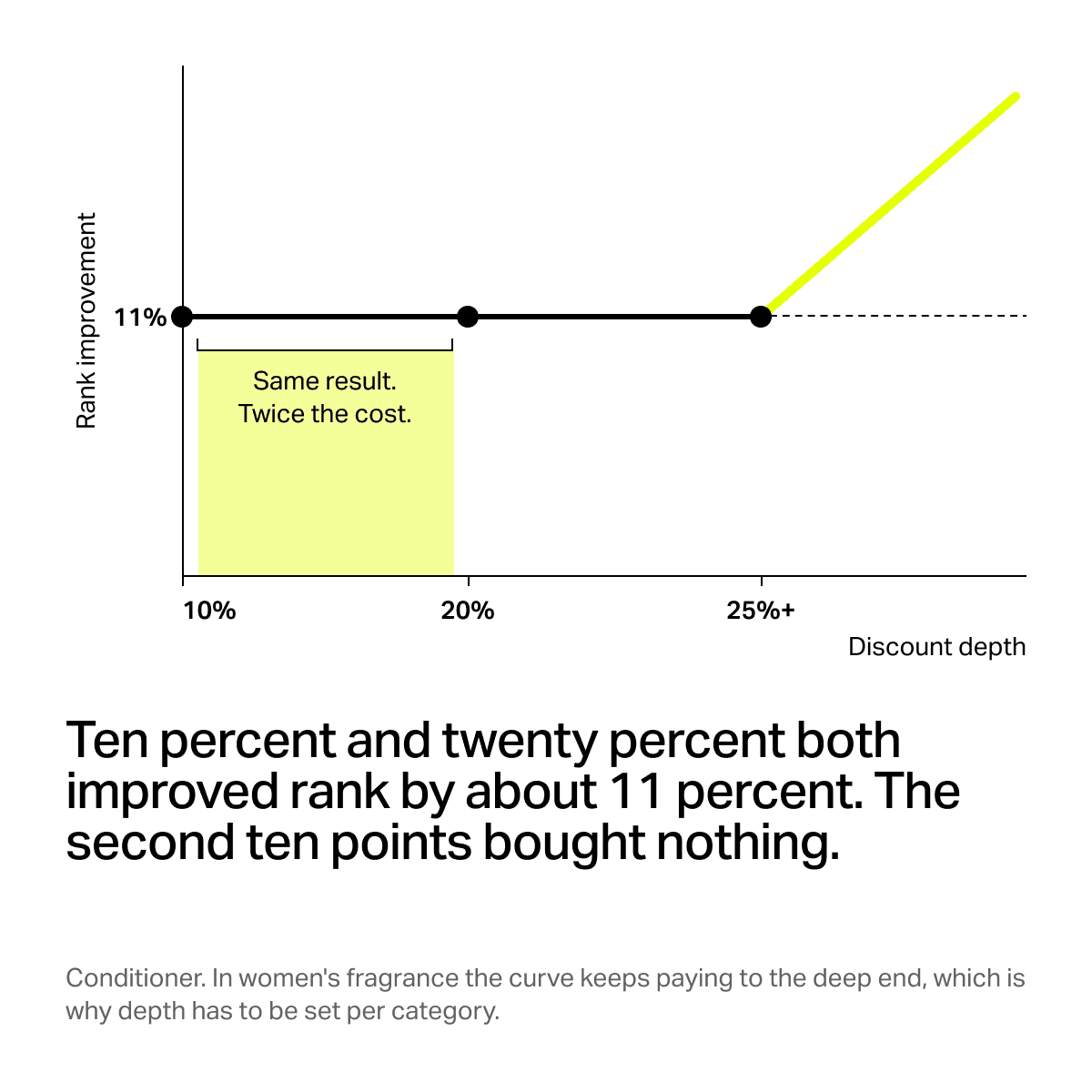
If your plan calls for 20% on conditioner, half of that discount is a gift with no return. Across a full event list, that kind of error can run between 10 and 20% of your funding, and none of it shows up in the post-event report because the revenue still looks fine. It would have looked just as fine at half the depth.
Women's fragrance behaves the opposite way. Every additional point of depth buys more ranking movement, all the way to the deep end. That's a category where the argument over 25% versus 35% is worth having, because the answer changes the outcome.
Same budget, opposite advice. That's what makes deal depth impossible to set from experience alone. Experience in one category can actively mislead you in the next.
Get the Shelf Ready So the Discount Has Something to Convert
A correct list and a correct depth still need a shelf that can convert the traffic a deal event brings.
Most teams already handle this part well: stock cover for the elevated volume, the main image and A+ Content in place, reviews holding steady on a recently changed variation, PPC budget lifted for the event window, and the deal badge actually showing on the listing.
The order matters. Retail readiness applied to the wrong product list is expensive work in service of a decision that was already wrong. The three checks from our previous blog post build the list. Depth-setting comes next. Readiness makes the list actually work once both are correct.
A category that responds well to a discount is still a category where you can lose money if the depth is wrong or the shelf isn't ready. The data narrows the decision, but it doesn't make it for you.
Put a Number Behind the Category's Real Response to Price
Take a typical event plan with twenty products and a fixed funding envelope.
Removing products on unresponsive shelves releases funding without losing anything measurable. Shifting weight from the budget tier toward the tier where price actually works increases what the remaining funding buys. Setting depth per category instead of by habit stops the overpayment in categories that saturate early.
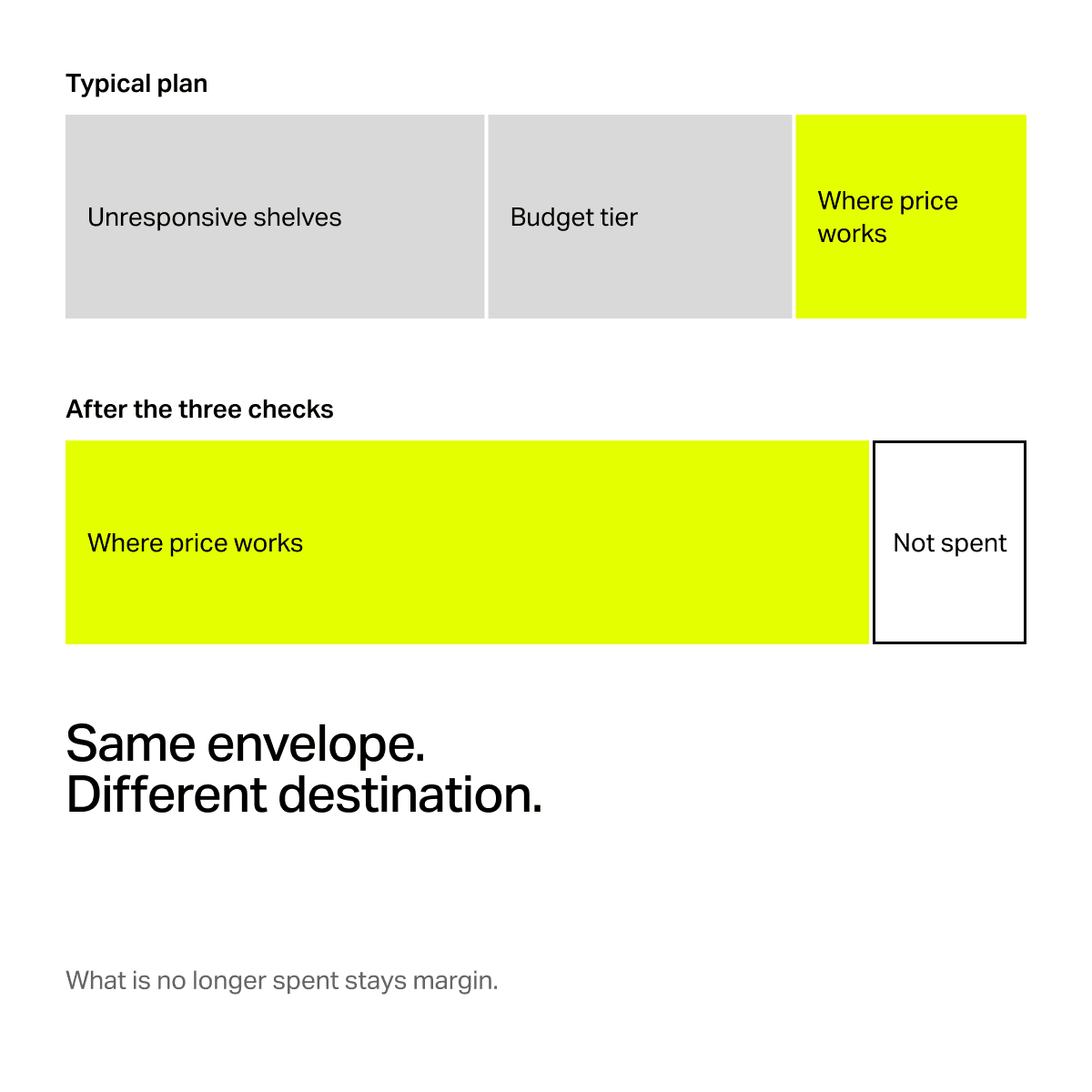
None of those three changes requires more budget. They redistribute the same envelope toward the places where it converts, and whatever you don't spend stays in the margin line.
The information needed to make this decision correctly is rarely in the room when the deal list gets built. That's the real reason these plans stay wrong: the meeting runs under time pressure, from last year's file, with nobody holding category-level numbers.
The measurement itself isn't exotic. Compare products that changed price against comparable products that held theirs, over the same window, in the same category, and track what happened to the ranking. Do that across enough price changes and enough products, and the category's response becomes a number with a range around it instead of an opinion.
It takes a reasonable volume of observed price changes in the category, a control group that held price, and enough discipline to throw out events contaminated by stockouts, review bursts, overlapping changes, or deal badges. That cleanup work is most of the effort.
The output is a small set of numbers per category: does price move rank here, by how much, at what depth does it stop paying, and does the answer change by price tier. With those numbers in hand, the same ten-minute meeting produces a very different list.
Know What the Numbers Cannot Tell You
- They measure ranking, not units sold. Rank is the mechanism a deal event runs on, and it's what a discount is actually buying, but a brand still has to convert that visibility into sales.
- They describe short windows. A deal event is a short window, so that fits the use case, but the numbers say nothing about what repeated discounting does to a brand over a full year.
- They come from observed price ranges. A category measured between 10 and 35% tells you nothing about what happens at 50.
Run the Checks Before Your Next Planning Round
The core takeaway: the list is the decision, and depth is only the adjustment. Which products deserve a slot, and at what price tier, decides more of your outcome than how deep any single discount runs. Before you build your next deal list, run these three questions in order:
- Does this category convert a discount into rank at all, and by how much?
- Is this specific product in the tier where that conversion actually happens?
- And is there anything on the list that should come off entirely so its funding can go where it works?
Only after those are answered should you set depth per category, at the point where the curve stops paying.
Before your next event, pull the category-level price response data for your top five deal candidates and set depth against that curve instead of last year's number.
Have a question about setting the right deal depth for your Amazon categories? Reach out to us.