TikTok Shop changes faster than any other marketplace we work on, and so far it has moved in the same direction in every country. At the start, TikTok paid for reach so that creators would show up. Creators came, brands followed, and now that both sides are crowded, the free reach is gone. For a brand nobody knows yet, the first one to three months decide almost everything.
You need a working base of creators, every video needs paid support from day one, and the commission has to be one you can still pay a year from now. TikTok Shop in Germany still leaves more room for that than most brands expect, although the window is smaller today than it was a few weeks ago.
The call we keep getting
Every few weeks we have the same conversation. A brand has opened its TikTok Shop, listed the range, sent out samples and used the outreach tool to message a few hundred creators. Two weeks later there are a handful of replies, three or four videos and almost no sales. The question on the call is usually whether the products are wrong for TikTok.
In most cases the products are fine. What changed is the market around them. Six months ago the same brand would have found creators with half the effort, and the videos those creators posted would have travelled much further on their own.
How TikTok Shop got here
It helps to look at it from TikTok's side. When TikTok Shop opened in a country, it had products and buyers and almost nobody who wanted to make content. So TikTok made content worth making. Videos that linked a shop product got pushed hard by the algorithm, and in the early phase it was rare to see a creator video with a shop link that stayed below 100,000 views.
Creators who made money told their creator friends, and more creators arrived. Once enough creators were selling, more brands came onto the platform, because that was where the sales happened. TikTok Shop is scaling on exactly this flywheel today.
When supply and demand had both grown, TikTok had no reason to keep buying reach for everyone. The organic boost was turned down step by step, and in many of the accounts we look at it has practically disappeared. Videos no longer get the abnormal push they got in the first months.
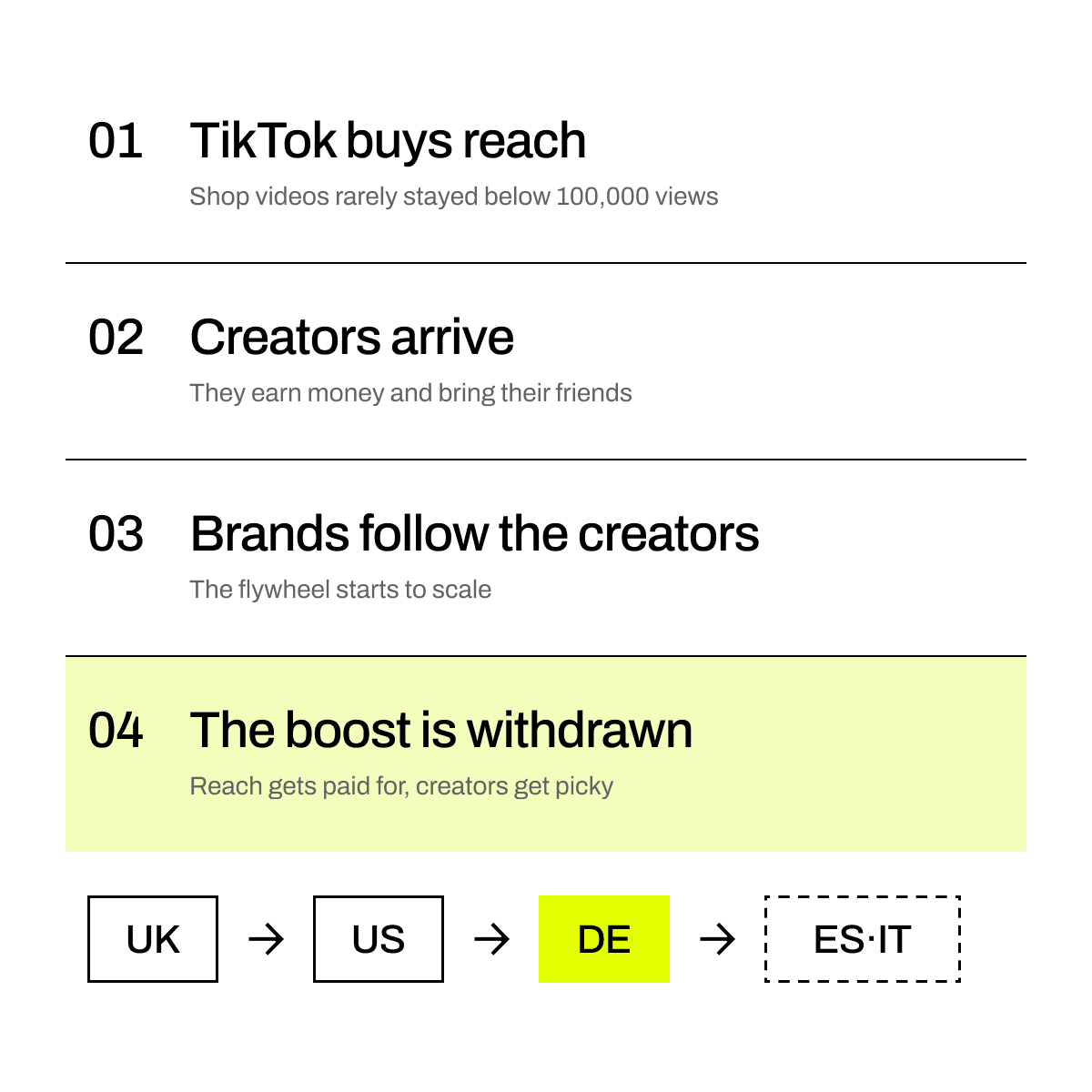
We watched this sequence in the UK, then in the US, and now in Germany. Spain and Italy are earlier in the cycle, and I expect them to go through the same phases. What surprises most brands is the speed. In Germany the gap between easy and hard was a matter of months, and some changes we noticed from one week to the next.
Creators got picky
The withdrawn boost has a second effect, and it hurts new brands more than the lost reach. Creators now have far more brands to choose from than they have time for, so they go with the brands that have proof. Either the brand is well known and sells anyway, or it already runs serious GMV on TikTok Shop and a creator can see that others are making money with it.
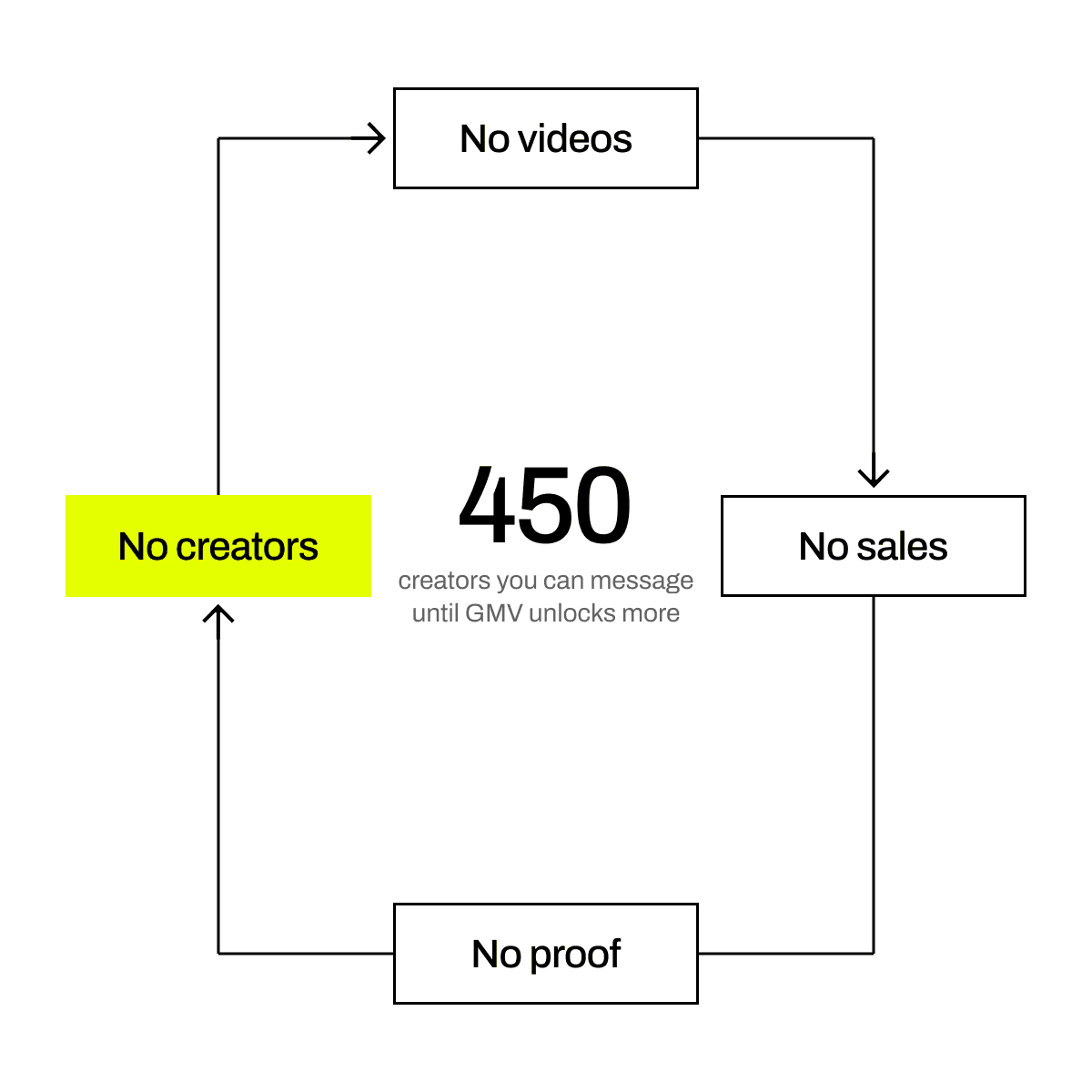
Without proof you get no creators, and without creators you cannot build proof. Listing products does nothing on its own, because nobody buys a product they have never seen in a video. Someone has to make the content first, and as an unknown brand you are asking creators to take that risk with you.
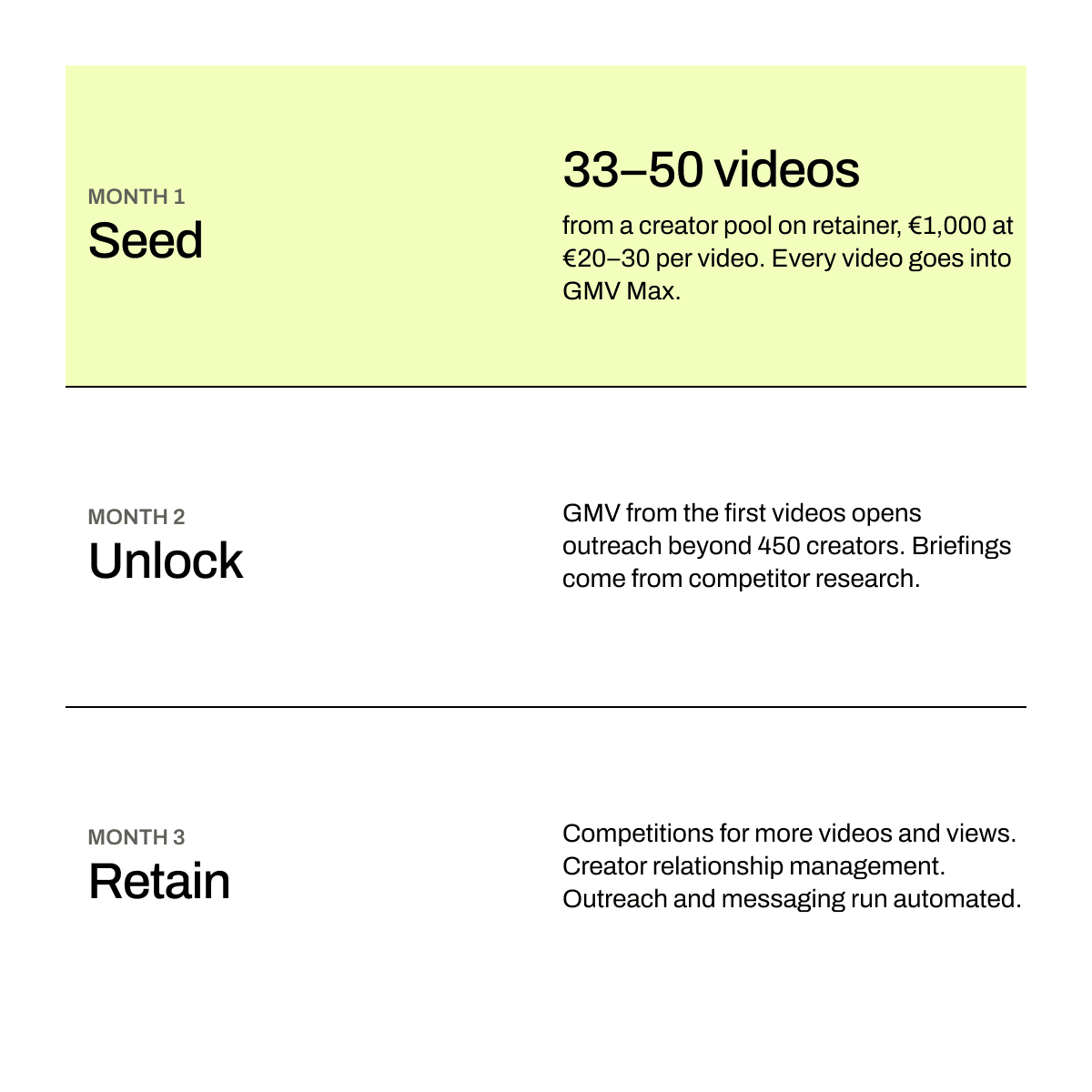
TikTok adds a hard limit on top. A new shop can message about 450 creators through the platform's outreach. More outreach unlocks only when videos get made and those videos generate GMV. If your first 450 messages produce three videos and no sales, you are stuck.
The usual reaction makes it worse
The reflex we see most often is the commission. A brand offers 30, 40 or even 50 percent affiliate commission and hopes that money will do what reputation cannot. Sometimes that works for a few weeks. Then the brand looks at its margin, has to bring the commission down to something sustainable, and loses the creators it just won.
On TikTok Shop the long-term asset is the relationship with your creators. We have started using CRM in a different sense, as creator relationship management. A creator who has made money with you, gets fast answers and knows what comes next will make the tenth video. A creator who joined for 50 percent and was then cut to 10 will leave and tell other creators why. Most of the launch budget ends up as sunk cost.
The second reflex is to wait for organic reach. For an unknown brand in the current phase, that is close to hopeless.
The sales mix has flipped
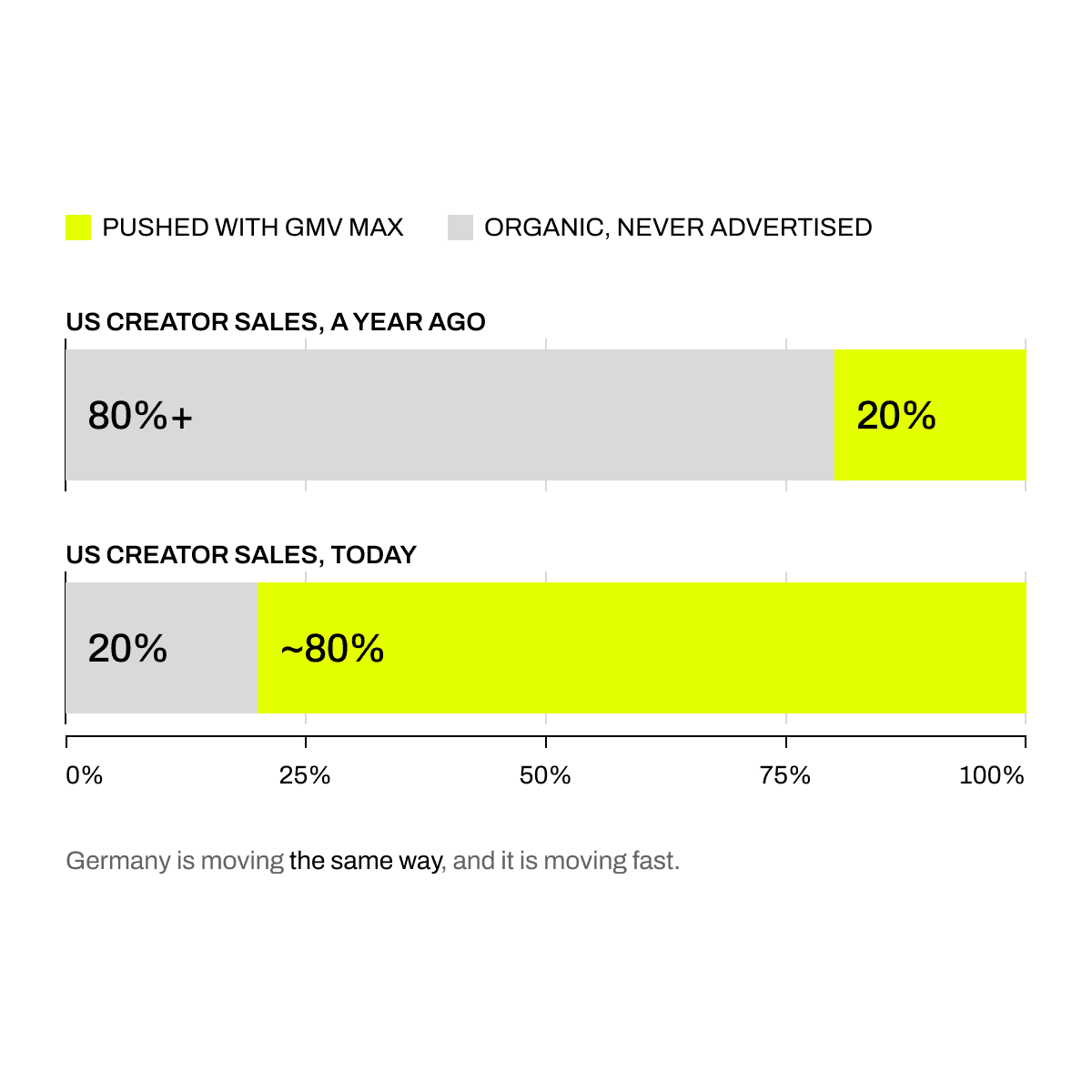
In the US accounts we manage, more than 80 percent of creator sales came from videos that were never advertised a year ago. Today roughly 80 percent of creator sales have a GMV Max touchpoint, so the video was pushed through a paid campaign at some point before the sale. We see the same trend in Germany, and it is moving quickly.
These figures come from our own accounts and are an estimate across them. TikTok does not publish this number. The direction is clear enough that we now plan every launch around it.
For a new brand this leads to one rule. When a creator makes a video for you, you push it with GMV Max straight away. The creator gets more reach and earns more, you get the sales, and the GMV unlocks your next round of outreach. Tell creators this before they film. Saying that you will put ad budget behind their videos is one of the strongest arguments an unknown brand still has.
What the German market looks like right now
For research we use Kalodata and Reacher. For TikTok Shop they do roughly what Helium 10 or Jungle Scout do for Amazon. They show which brands sell, how much, through which products and which creators, and at what commission.
These are the top ten brands in TikTok Shop Germany by GMV over the last 28 days, as Reacher showed them in late October 2026.
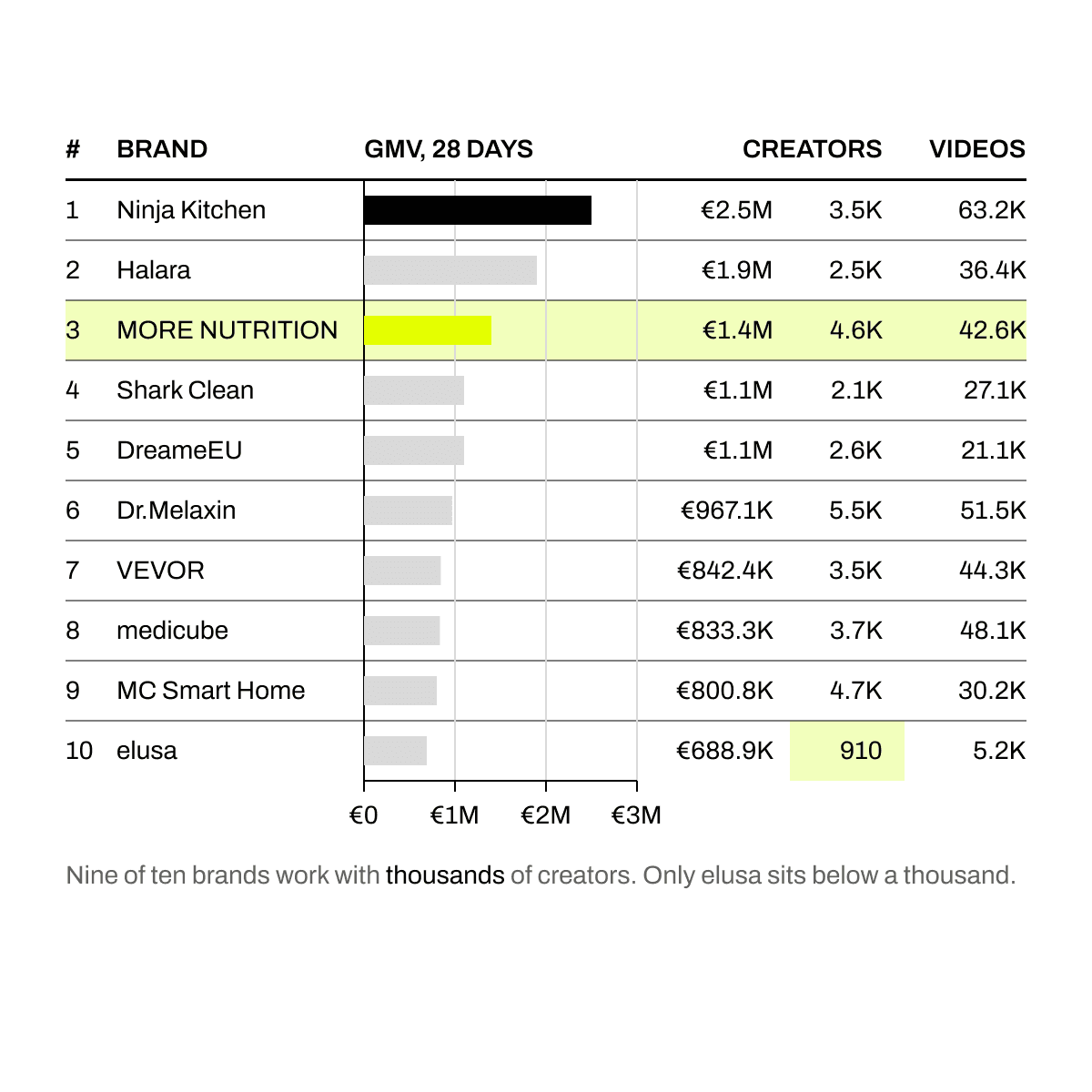
Source: Reacher, TikTok Shop Germany, last 28 days, pulled in late October 2026. All values are tool estimates.
Half of the list are appliance brands, which fits how products with a strong demo perform in video. More telling for a new brand is the creator column. Nine of the ten brands work with several thousand creators, and only elusa sits below a thousand. That is the competition for a creator's time when an unknown brand sends its first message.
How we take a competitor apart
Before we start with a new brand, we check whether that brand, or a comparable one with comparable products, already sells on TikTok Shop in the US, the UK or Germany. If it does, we go through it level by level. MORE NUTRITION works well as an example because it ranks third and its data is visible in these tools.
At brand level, MORE NUTRITION shows €1.4M GMV over the last 28 days, €9.1M all time, 4,594 creators and 42,589 videos across 111 products.
At product level, one product carries most of that. The More Adventskalender 2026 at €119.99 shows €955.9K over 28 days and 7,419 units, about two thirds of the brand's GMV in that window. Its open collaboration commission is 15 percent. The next products in the list, a flavour powder, a tasting box and a multipack, run at 10 percent and between €48K and €84K each.
At creator level the picture gets concentrated. The top creator on the advent calendar generated €202.6K with 15 videos, roughly a fifth of the product's GMV from one person. The brand's own account sits at €53.5K across all products.
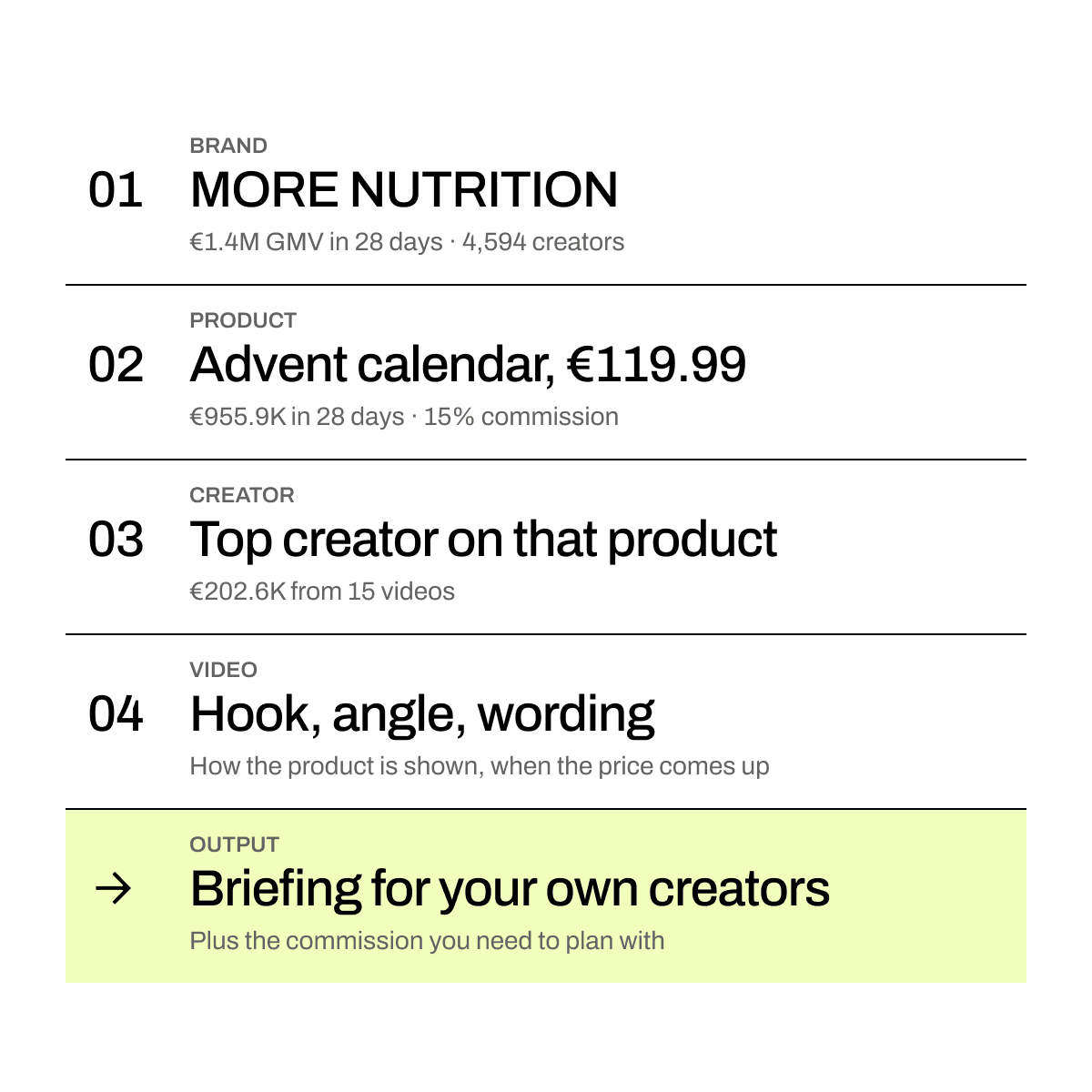
Then we watch the videos. We look at which hook opens them, which angle the creator takes, which words they use, how the product is shown and when the price comes up. From the videos that sell the most, we write a briefing for the creators of the brand we work with. Our creators do not have to do that analysis themselves, and they start from something that is already proven in the category.
The same research tells you which commission to plan with. If the leader in your category pays 10 percent on its regular range and 15 on its hero product, offering 5 will be a hard sell, and offering 40 is money you will want back later.
This example also has a trap that is easy to miss. It is now November, and a 28-day window right now is dominated by an advent calendar. Pull the same brand in March and the product ranking will look completely different. Before you copy a playbook, check whether the product carrying the GMV is seasonal.
TikTok Shop can pay for itself
For a long time we told brands to treat TikTok as an awareness channel. Seen on TikTok and bought on Amazon is still very real. Plenty of people use TikTok as a search engine, find a product in a video and then buy it on Amazon where they have Prime. That effect alone can justify the effort.
In Germany, TikTok Shop can also be a profitable sales channel of its own, and the math is simpler than most people expect. Assume shipping costs the same on both platforms. TikTok Shop charges a 9 percent marketplace fee, and Amazon charges 15 percent in most categories. Give creators 5 percent and you are at 14 percent on TikTok Shop, still below Amazon's fee alone. On Amazon you spend another 10 to 15 percent on advertising anyway. Put the same 10 to 15 percent into GMV Max and TikTok Shop lands at 24 to 29 percent of revenue, Amazon at 25 to 30.
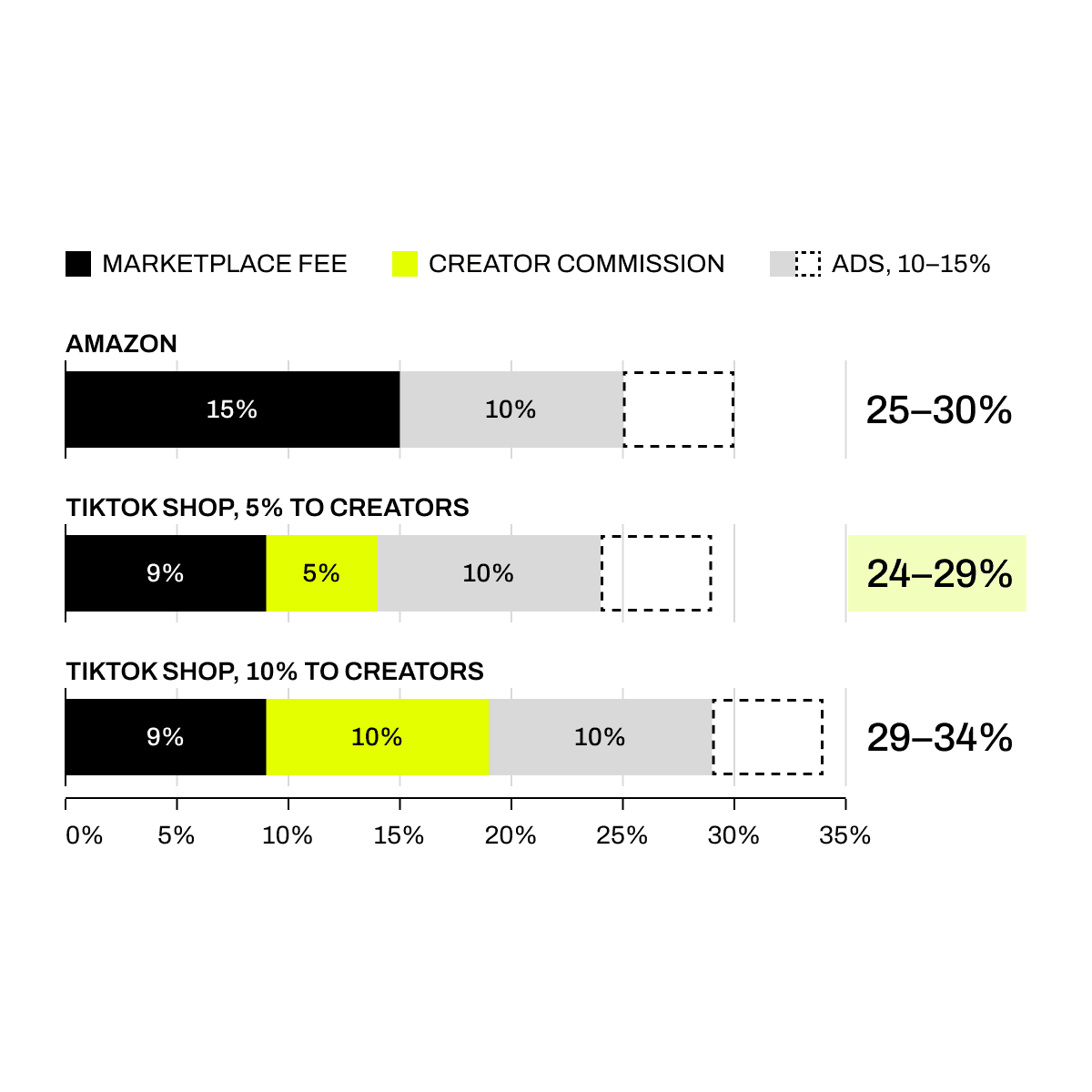
At 10 percent commission you pay a few points more than on Amazon. Whether that is worth it depends on how much of your TikTok reach also lands on Amazon, and you will have to estimate that number for your own brand. TikTok Shop offers its own profitability tools, but these three lines in a spreadsheet are enough to see whether your product can work.
The first 90 days
Everything depends on getting past the first videos, because only videos with GMV earn you the right to message more creators. In the first one to three months the job is to build a creator base that works, keep producing videos with it, push those videos and keep the flywheel turning.
In practice that means:
- Every video goes into GMV Max as soon as it is live.
- Creators hear before their first video that you will push their content.
- The commission is one you can still pay in a year.
- Existing creators get competitions. Whoever doubles their video count this month gets a bonus, and videos above a set number of views earn an extra payment.
- The briefing comes from the competitor research, so creators do not have to guess what works.
For brands in a hurry, and for brands that cannot find creators at all, we now go one step further. Through other projects we have built a pool of creators who already have social proof, and we work with them on a retainer. This is closer to classic influencer marketing, where you pay a fixed fee to get the ball rolling. At 20 to 30 euros per video, a budget of €1,000 buys between 33 and 50 videos. Those go into GMV Max, produce the first sales and make the brand visibly attractive to creators who check its numbers before they say yes. The GMV from those videos also unlocks the next outreach round.
Automate the loop once it runs
Once the loop works, most of the work repeats itself. Someone has to find creators who fit, send outreach, follow up, ship samples, answer questions and chase deadlines. We use Reacher to automate creator management and messaging, which frees up time for the parts that need a person: the briefing, the relationship with the top creators and the decision about which videos get more budget.
The rhythm that has worked for us is weekly and monthly. Every week we look at which videos get ad budget and which creators are active. Every month we run the competitor drilldown again, because winning hooks in this market wear out quickly.
What this approach does not solve
- The data in Kalodata and Reacher is estimated. In our example the top creator shows €202.6K with the brand over 28 days on one screen and €100.22K+ total GMV over 30 days on the profile. The windows and definitions differ, so use these tools for direction and order of magnitude and never as accounting.
- The 80 percent figure is our observation across our own accounts. Your category may be further ahead or behind.
- Bought videos from a creator pool can start the flywheel, but they cannot keep it spinning. If the product does not convert in video, 50 videos will show you that faster.
- The Amazon halo is hard to measure. If you judge TikTok Shop on its own P&L you undervalue it, and if you credit every Amazon uptick to TikTok you overvalue it.
- The rules keep moving. The outreach limit, the fee levels and the way GMV Max works have all changed before and will change again, so parts of this article will be out of date within months.
What to do this week
Open Kalodata or Reacher and pull your three closest competitors in the TikTok Shop market you are going into. For each one, find the product carrying the most GMV, check whether it is seasonal, note its commission, and watch the five videos with the highest GMV from start to finish. Write down the hook, the angle and the moment the price comes up. Then put your own product into the three-line calculation above, at a commission you can sustain.
If both look good, start now, because every few weeks of waiting makes the entry a little more expensive.
This is the work we do in the first weeks with every new brand, and if you would rather not do it alone, talk to us.