
The decision that costs the most margin at a deal event is which products make the list in the first place. That call usually gets made in about ten minutes.
The meeting runs the same way almost every time. A Prime Day is coming, or a Brand Day, or something off-calendar that Amazon offered on short notice. Someone opens last year's file. The top sellers go on the list because they always go on the list, someone picks a depth that feels roughly right, and the conversation moves straight to stock and creative.
That whole exchange takes ten minutes and commits more margin than anything else in the plan.
Agency View vs. Owner's View
We look at this from two angles. The agency view treats deal funding as part of a client's budget, and someone eventually asks what it bought. The owner's view is how we read these decisions for the private label and D2C brands we work with. For them, every point of CM3 (contribution margin after COGS, fulfilment and advertising) feeds straight into the brand's valuation. Giving 20% where 10 would have done the same job carries all the way through to that number.
Both angles land on the same conclusion. Discount depth is the second decision. Which products deserve a slot at all is the first one, and it carries the bigger lever.
Why Top Sellers Always Win the Argument, and Why That's the Wrong Test
There is a reasonable logic behind picking top sellers. They have the deepest sales history, the most reviews, the highest conversion, and the safest revenue forecast. A list of proven products is easier to defend to a commercial lead than almost anything else.
That logic holds until you measure what a discount actually buys. A discount buys visibility within a specific category, and categories differ far more than most planners expect. Whether a price cut moves your ranking depends less on your product and more on the shelf it sits on. A top seller on a shelf where price does nothing is a weaker deal candidate than the number four product on a shelf where price does everything.
That sounds abstract until you put numbers on it.
Check One: Find Out If Your Category Reacts to Price at All
Take two categories from the same aisle.
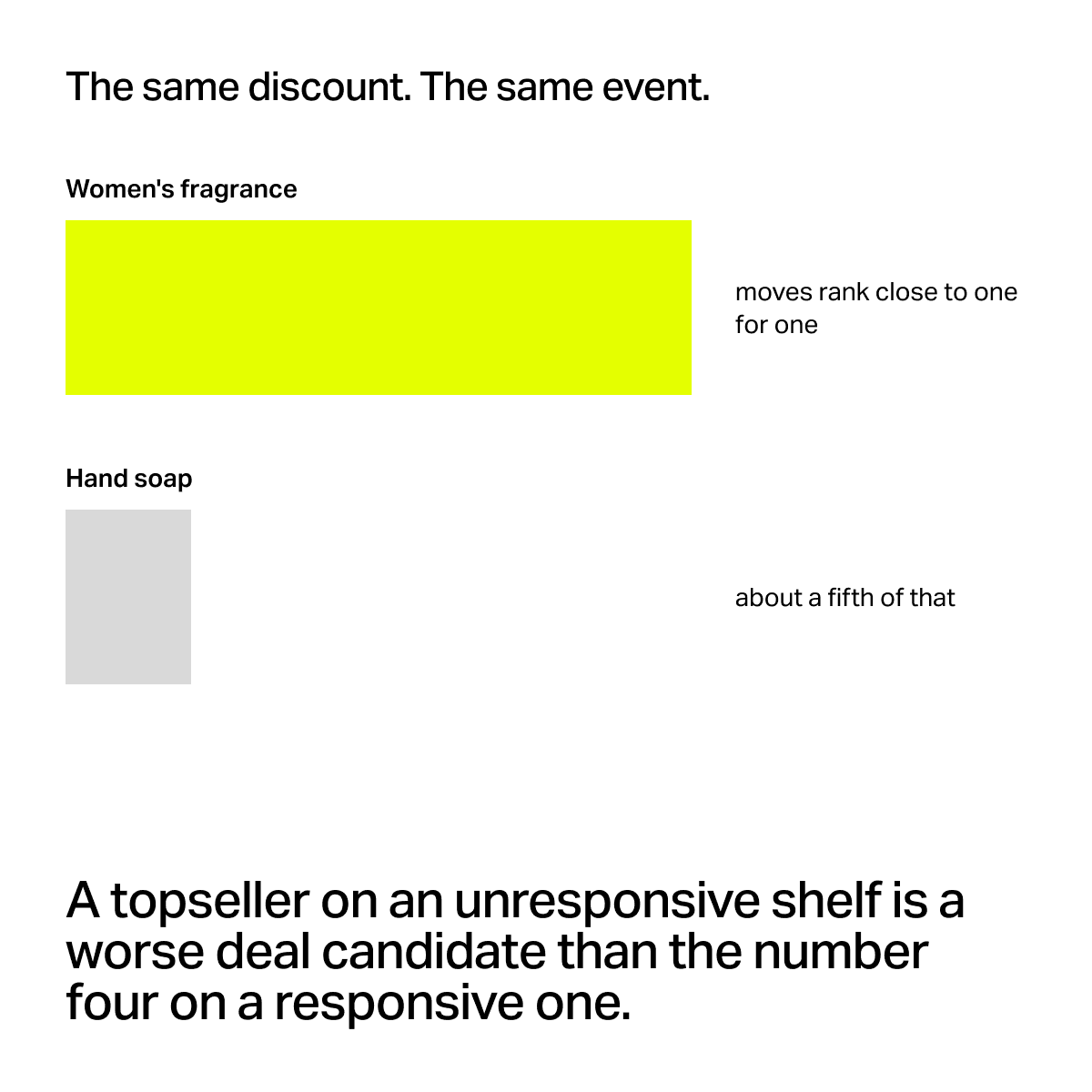
- In women's fragrance, a discount moves the ranking close to one for one. Cut the price by a given amount and rank improves by roughly the same proportion, all the way up through deep cuts around 35%.
- In hand soap, the same discount delivers about a fifth of that result. Even deep cuts barely move the needle. You can double the discount and watch almost nothing happen.
Same retailer, same event, same funding mechanics. One shelf converts a discount into visibility. The other absorbs it.
Run the numbers on a hand soap deal and the pattern is clear: the money leaves your margin, the ranking barely moves, and the sales lift you record is mostly the lift the event traffic would have delivered anyway. You paid for something the shelf was going to give you regardless.
The first question is whether this shelf pays back a discount at all, long before you get to which products should participate.
Check Two: Confirm the Product Sits in the Right Price Tier
The second check surprises people most, because it cuts against instinct.
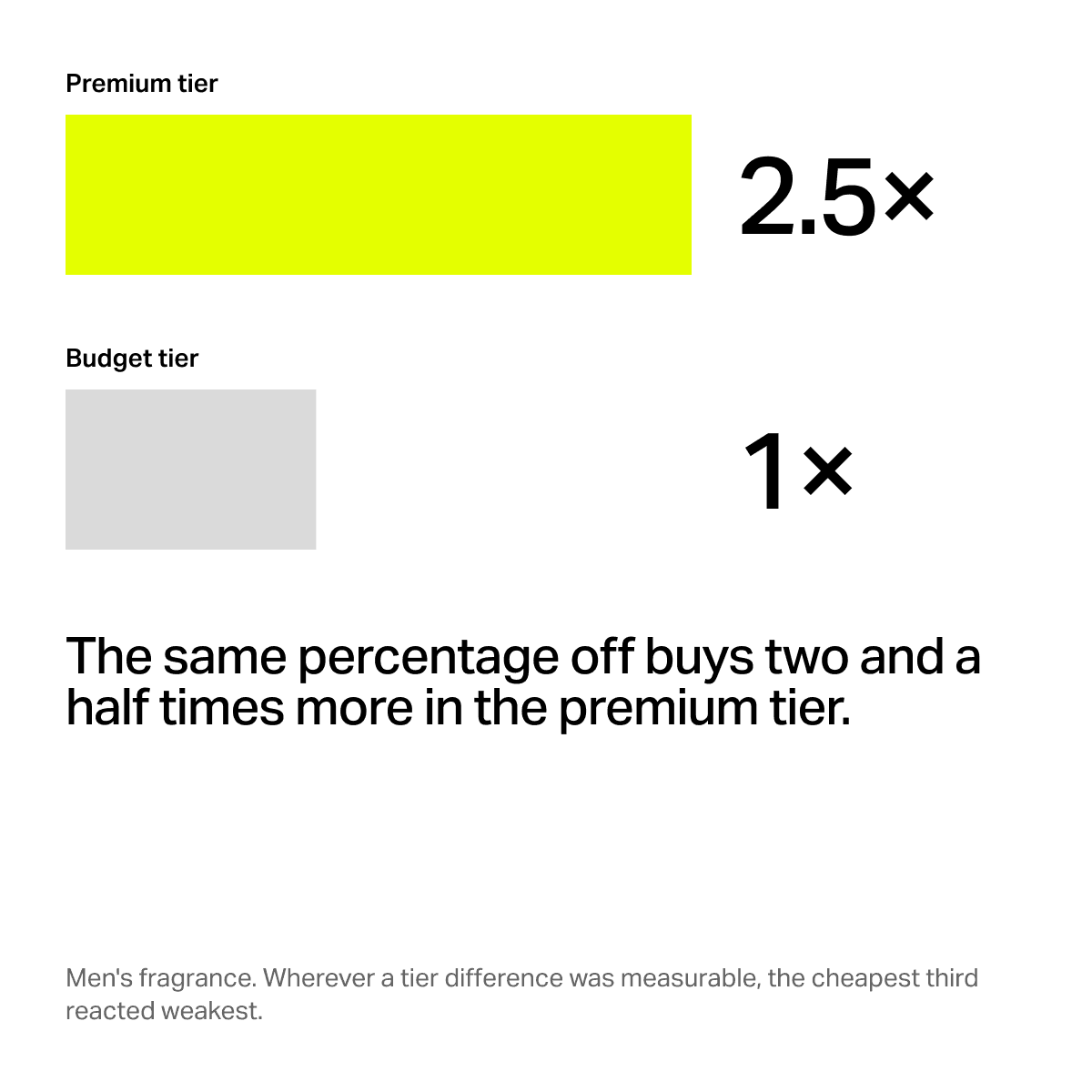
The instinct says cheap products respond best to price: lower barrier, more price-sensitive shopper, bigger percentage effect. In every category where we could measure a segment difference, the opposite held. The cheapest third reacts weakest.
- Men's fragrance shows the gap plainly. The same relative discount buys roughly two and a half times as much ranking movement in the premium tier as it does in the budget tier, in the same category, during the same event window.
- Shampoo pushes the pattern to its extreme. Price works almost only in the upper tier, and an event built on budget bestsellers there runs into very little.
There is a plausible reason. In the budget tier, everything is already cheap, discounts are constant, and another 10% reads as noise. In the premium tier, a discount is an event in itself. It changes the decision for a shopper who was hesitating.
The practical consequence stings a little. Volume products, the ones with the thinnest margin and the most pressure to move stock, are the natural candidates for a deal slot. They are also, measurably, the slot where funding does the least. A deal plan weighted toward cheap volume products funds the weakest part of the portfolio and calls it efficiency.
Check Three: Know Which Shelves to Skip Entirely
This is the hardest one to say out loud in a planning meeting.
Sometimes the right call is to skip a shelf entirely. In hand soap, even a deep discount moves almost nothing. A deal there costs funding and margin and returns no visibility. The shelf itself causes the problem, so no depth fixes it.
Nobody enjoys proposing this. Skipping a deal can look like skipping your job, and there is always a commercial argument that presence matters or that competitors will show up. Sometimes that argument is right, and a defensive slot on a flat shelf is a deliberate choice.
Make it a deliberate choice. If you know a category won't convert a discount into rank, you can still decide to run one and book it as share defense. Just don't put it on the list because it was on last year's list, and then wonder why the post-event report comes back flat.
Across a full deal plan, the products you remove tend to be worth more than the depth you fine-tune. Every ASIN you cut releases funding that lands on products where it actually moves something. What you don't spend stays margin.
The expensive part of a deal event is the ten minutes it takes to decide which products go on the list. Almost nobody treats that decision with the same rigor they apply to discount depth.
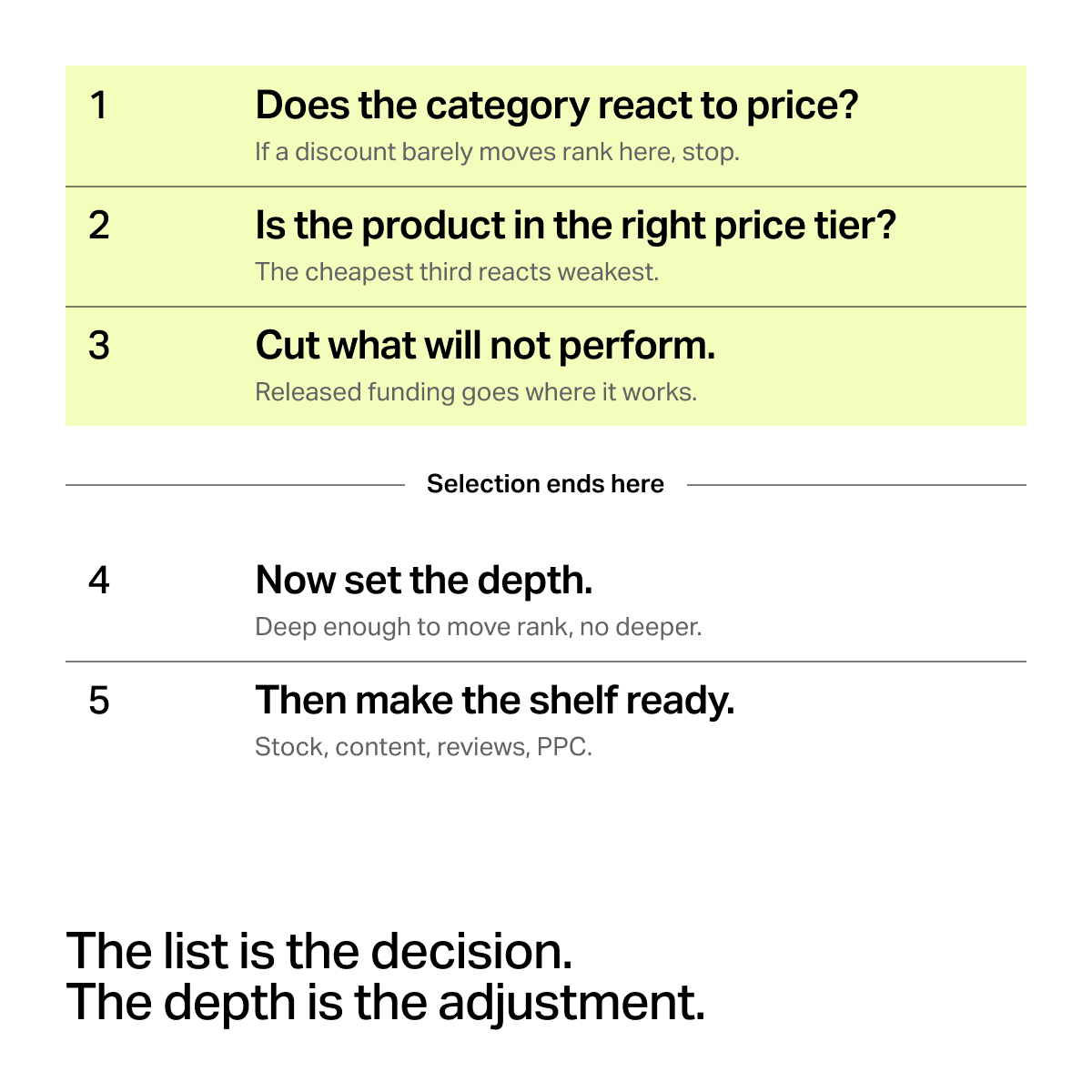
Fix the List First, Then Talk About Depth
Building the right deal list comes down to three checks, run in order, before a single percentage gets discussed:
- Does this category convert a discount into rank at all, and by how much?
- Is this specific product in the price tier where that conversion actually happens?
- Is there anything on the list that should come off entirely, so its funding can go somewhere it works?
Get those three right and the depth conversation gets a lot easier, because you're no longer arguing about how deep to cut on products that never belonged on the list.
We'll follow up on this in our next blog post: once your list is correct, category data tells you exactly where a discount stops paying and how to get that proof into the room before your next planning meeting.