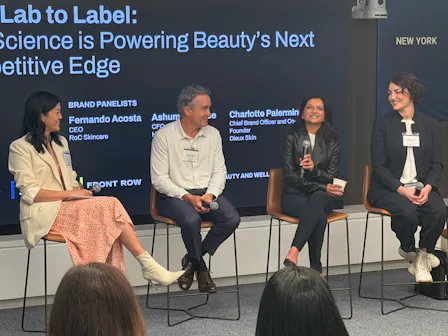
FROM LAB TO LABEL: HOW SCIENCE IS POWERING BEAUTY’S NEXT COMPETITIVE EDGE
For most of the industry's history, efficacy lived in the fine print while aspiration did the heavy lifting. That started shifting before COVID, accelerated hard through it, and hasn't slowed down since. On Amazon in 2025, category searches grew faster than branded ones, painting a clear picture about how consumers are searching for products. Scalp treatments are up 69% year over year. Searches for "creatine for women" are up 352%.
Beauty has become a health decision, and health decisions require proof. The panel "From Lab to Label: How Science is Powering Beauty's Next Competitive Edge" made the case for why that shift is permanent, and what it costs brands that haven't caught up.
Michelle Lee, Chief Brand Officer at Front Row, moderated a conversation with Fernando Acosta, CEO of RoC Skincare, Ashumi Shippee, CFO of Haus Labs, and Charlotte Palermino, Chief Brand Officer and Co-Founder of Dieux Skin. Three brands at different price points, in different categories, built on different consumer promises. The through line was the same: in a market where consumers are researching molecules before they buy moisturizer, scientific credibility has stopped being a differentiator and started being the cost of entry.
The data backs the room. On Amazon in 2025, searches for specific ingredients and clinical claims are growing faster than branded searches. The modern beauty and wellness consumer is savvy; they don’t want to be told a product works when they can research why.
Fernando Acosta has spent years building the answer to that question into RoC's brand architecture. Clinical proof is structural to RoC’s ethos. "Clinical proven is part of our logo," Acosta said. The question his team asks before commissioning a study is whether a specific claim deserves the rigor of a clinical trial.
That distinction is more loaded than it sounds. Clinical studies are expensive. Running them without a strategic rationale is waste. Running without them in a category increasingly governed by substantiation requirements is a liability. Acosta's framework is simple: if you're going to make the promise, build the proof. The category is built on ingredients with the promise of measurable change over time, so soft claims don’t hold for the modern, informed consumers.
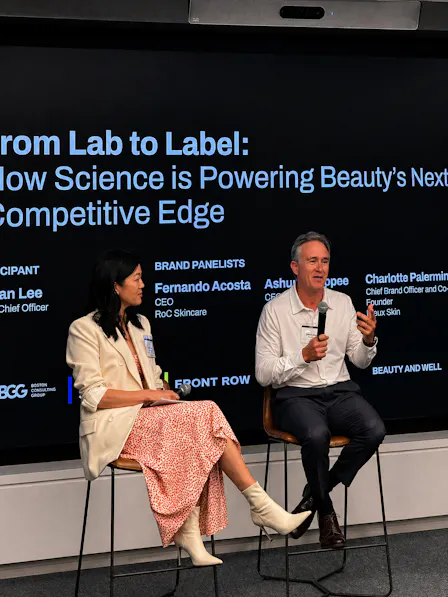
Charlotte Palermino arrived at the same destination from a different direction. Dieux Skin was built around a clean formulation ethos, which immediately put Palermino in the middle of one of beauty's most contentious definitional debates. What does clean actually mean?
Her answer was to look overseas at the EU’s standards, which sets a higher bar than U.S. regulation. Palermino built a toxicologist into the brand's advisory structure as an operational check. This person is someone in the room who can inform, help educate, and tell the brand when a claim crosses a line. That line, Palermino argued, is more consequential than most brands acknowledge.
If you start making claims about the appearance of dark spots or wrinkles, those are cosmetics claims. There are more regulations around science because it's more rooted in truth and evidence.

The term she used for the alternative was science washing, making the aesthetic moves of a science-forward brand without the substantiation to back it up. In a market where consumers are more skeptical than ever and AI is increasingly mediating product discovery, science washing is a short-term play with a long-term cost. Proof density, as the previous panel noted, is becoming a ranking variable. Brands that can't support their claims structurally won't surface.
She also offered the panel's most unexpected data point: red light therapy, now a booming skincare and wellness category, originated from NASA research. The consumer didn't know that. It took brands willing to do the translation work to turn a piece of aerospace science into a growing household staple.
Ashumi Shippee brought the Haus Labs perspective, which sits at a different intersection: the place where skincare and color cosmetics are actively converging. The Haus Labs brief starts with a question the category has been circling for years: what if makeup was also skincare, not in the marketing sense, but in the formulation sense? That requires a different kind of formulation conversation, and one that pulls from both categories and asks the lab to deliver on both sets of promises simultaneously.
It's a harder brief. It's also, increasingly, the brief the market is writing.
What connected all three panelists was a shared rejection of science as theater. Brands operating at the forefront of clinical credibility have done the work to understand what their consumers actually need. Then, they built the proof around it, and found language to close the distance between the lab and the label on the shelf, or increasingly, on Amazon.
That last part is the hardest. It takes translating retinaldehyde into a reason to believe, or turning a toxicologist’s sign-off into consumer confidence, or even making NASA-grade light therapy a cutting-edge part of your wellness routine. The science has to be real and the story has to be human.
If you’re interested in learning how Front Row helps brands connect the entire system through Amazon and off-channel execution, connect with us here.