
HOW AI SEARCH IMPACTED
BFCM 2025
Article Summary
In 2025, AI agents reshaped Black Friday and Cyber Monday by accelerating research, personalizing offers, and driving massive growth in AI-led traffic and revenue. Shoppers moved faster, spent more, and relied on AI as a trusted shopping assistant. Looking ahead to 2026, agentic commerce, deeper personalization, and increased competition from platforms like Gemini will push brands to optimize for AI visibility or risk being left out of high-intent shopping flows altogether.
AI’s Impact on BFCM 2025
The story of Black Friday is one of change and adaptation. In the 2000’s, Black Friday was known for its ‘door-buster” deals designed to encourage shoppers to show up at physical stores at the crack of dawn for a chance to grab a large screen TV in a sea of other shoppers. In the 2010’s, this pivoted to include online shopping. The 2020’s introduced the idea of “Cyber Monday”, adding to an ever-growing list of promotional holidays. Now we have entered the next chapter of Black Friday and Cyber Monday (BFCM), which introduced AI agents that shifted BFCM from a one-size-fits-all approach to a personalized shopping experience for those who use it.
Shortened Shopper’s Research Windows
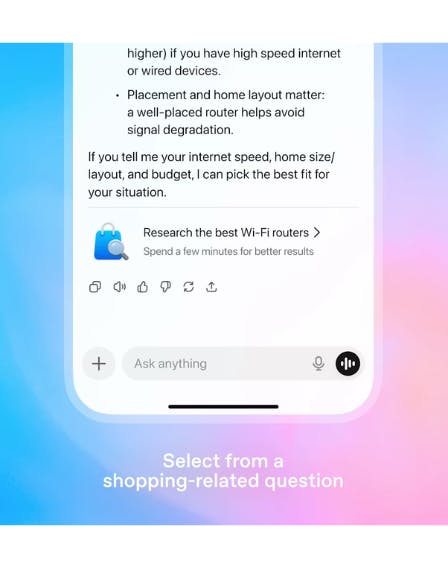
BFCM 2025 saw shoppers using AI-led shopping journeys to shorten their research window, taking them from research to ready to purchase in a matter of minutes. Leading the charge was ChatGPT with its Shopping Research feature, launched on November 24, 2025.
Shoppers no longer had to wade through waves of unrelated offers to find the one that fit their needs. Instead, they could find a product that fulfilled the needs of their prompt and was reinforced by the reviews of their peers. For example, a runner could find a running shoe for their marathon training that fits the exact needs and solves their unique problems. Every chat is similar to a conversation with an expert delivering a pinpoint, concise answer. This helped more rapidly convert shoppers who would otherwise still be in the research phase, well after BFCM had already passed. Shoppers who in the past were never converted into customers.
AI Shifted BFCM Toward Personalized Offers
The use of AI also meant that deals were highly personalized. In some cases, shoppers were using AI agents that they had been talking to for the past year as close confidants, meaning each recommendation for “gift ideas for dad” was informed by an intimate understanding of the in’s and out’s of shoppers' likes and dislikes, even more so than cookies could deliver in a post-GDPR landscape.
A small percentage of stores that were accepted into programs were also able to leverage agentic commerce, that is, the end-to-end use of AI in shopping from research to purchase, with the checkout happening in platform. The cool thing about this is that it allows all purchases to be processed through the store selling the product, meaning that vendors remain the merchant-of-record and maintain all sales data and revenue.
Higher AI Traffic Volume
Year over year, stores have seen exponential growth in sessions via AI sources. This was in large part due to AI agents moving out of niche use and starting to become a day in a day out tool of the average shopper. In fact, Front Row AEO/SEO clients saw an average increase in sessions of 806.54% when compared to BFCM 2024.
When looking at the Friday to Monday period prior to BFCM 2025, sessions were still up 37.75%, showing that despite explosive growth in the use of AI YoY, there was still an increase in volume, specifically during BFCM, showing higher adoption of AI as a shopping tool, not just informational.
Higher AI Revenue
When looking at the Friday to Monday period prior to BFCM 2025, Average Order Value was up 80.22%, and AI Revenue was up 152.96%. This demonstrates a larger number of shoppers using AI chatbots to buy a higher amount of products for a larger total sum.
Our Bold Predictions for AI’s Impact on BFCM 2026
Trying to predict how AI will change in the next year, with so many updates in process and being planned, may be a fool’s errand, but we will try our hand at it.
Agentic Commerce Will Account for 10% of BFCM Sales
Agentic commerce has not been made widely available for use by merchants at this time, so it can be difficult to predict how it will perform once it has. If it does, in fact, become widely adopted by AI agents & merchants alike as a standard, I believe that we will see 10% or more of sales come through agentic commerce.
One note is that agentic commerce’s strength lies in its level of adoption both by AI agents and by the stores themselves. If it remains a bespoke solution as it is right now, I expect this to have a rather minimal impact on sales. If Apple announces its own agentic commerce solution through its partnership with Google on a Gemini-backed Siri, I expect this could reach 20%.

As mentioned above, the days of ‘door-buster deals’ to get shoppers through the doors at a brick-and-mortar location are long gone. I believe that we will continue to see further personalization in BFCM marketing via AI agents. This in itself is not a bold prediction and seems like the logical progression of digital marketing efforts. However, my prediction is that during BFCM 2026, we will see truly personalized offers based on chat history.

AI Will Further Personalize BFCM Marketing
The main detraction from this is that many LLMs currently have user agreements in place to prevent similar things. However, it is almost certain that we will see this change. OpenAI announced recently that they are testing ads in the US on free and Go tiers. I expect we could potentially see some ‘on-device’ solutions to this.
Gemini Will Reach 40% of AI Chatbot Market Share by BFCM 2026
In April 2025, the beginning of StatCounter’s tracking of AI chatbot market share, it looked like Google was finally caught behind the eight-ball, with Gemini only accounting for 2.85% of market share while ChatGPT controlled 88%. That, however, was short-lived. Since then, Gemini has been growing rapidly, up to 6.05% and even reaching up to 18.2% by some metrics.
Google has made it its priority not fall behind in the AI race. In fact, Google announced a $40 billion investment in Texas to build cloud & AI infrastructure, according to Yahoo Business in November 2025. This is only expected to continue as we move into BFCM 2026 and beyond.
How to Retain BFCM Shoppers in an AI-Driven Landscape
It’s no longer a question of when AI will impact e-commerce; that is already happening. We now shift our gaze towards how to ensure our sites don’t get left behind in AI-powered shopping flows. This means:
Optimizing product meta titles & descriptions to accurately reflect your product and services. This not only improved click-through-rates for traditional shoppers but also helps AI agents better understand and contextualize your product and service offerings.
Create unique, problem-solving content that is valuable to readers. Don’t just create content for creating content. In an environment where AI slop and copy-and-paste articles are the norm, quality content with real insights sets you apart for readers and in AI results.
Add schema to PDPs, blogs, FAQs, and more so that your site is easily accessible & digestible for AI agents. AI agents want to get in and get out. As a result, the more well-structured your site is, the more likely it is to be referenced in AI search results.
These elements are foundational to a healthy AEO approach, but as AI evolves, it is important to stay on top of evolving best practices. If your brand is struggling to stay ahead of the curve in the fast-paced environment of AI-powered search and e-commerce, Front Row can help you take the next step. Reach out to our team today to hear how our AEO & SEO experts can help elevate your brand above the noise and improve your visibility in AI search.
Don’t get left behind in 2026 while your competitors move ahead. Connect with our team of AI SEO experts here to learn how we can support your brand in this ever-evolving, unprecedented landscape.
AI SEARCH FAQS
How did AI agents change Black Friday and Cyber Monday in 2025?
AI agents transformed BFCM 2025 by shortening the shopper research window and replacing one-size-fits-all promotions with personalized shopping journeys. Instead of browsing dozens of deals, shoppers used AI tools like ChatGPT Shopping Research to move from product discovery to purchase-ready decisions in minutes, increasing conversion rates and average order value.
What is agentic commerce, and why does it matter for BFCM?
Agentic commerce refers to AI-powered shopping experiences that handle the entire journey from research to checkout within a single platform. During BFCM, this mattered because it removed friction, increased purchase confidence, and still allowed brands to remain the merchant-of-record, keeping ownership of customer data and revenue.
Why did AI-driven traffic and revenue increase during BFCM 2025?
AI-driven traffic surged because AI chatbots became daily shopping tools rather than niche research assistants. During BFCM 2025, Front Row clients saw AI sessions increase by over 800% year over year, while AI-driven revenue rose nearly 153%, driven by higher intent shoppers and larger basket sizes.
How will AI further personalize BFCM marketing in 2026?
In BFCM 2026, AI is expected to deliver truly personalized offers based on chat history and long-term user preferences. Rather than broad discounting, shoppers may receive recommendations and promotions tailored to their specific needs, interests, and buying behavior, making personalization a core driver of BFCM performance.
How can brands retain BFCM shoppers in an AI-powered shopping landscape?
Brands can retain AI-driven BFCM shoppers by optimizing product metadata, creating high-quality problem-solving content, and implementing structured schema across PDPs, blogs, and FAQs. These steps help AI agents better understand, trust, and surface a brand’s products during AI-led shopping journeys.