THE STATE OF PLAY IN BEAUTY & WELLNESS: KEY TAKEAWAYS FROM FRONT ROW X BCG X JEFFERIES
Front Row, BCG, and Jefferies convened beauty and wellness industry leaders in New York this week to examine the state of the market. Before the brand panels, before the founder stories, before the deal talk, Sasha Radic of Jefferies, Pierre Dupreelle of BCG, and Christopher Skinner of Front Row laid out the market as it actually is, not as it was two years ago, not as brands wish it were, but as the data reads today.
The picture that emerged was one of a category with real structural tailwinds, a shifting consumer, and a shrinking margin for strategic error.
Start with the macro, because the macro matters more than most beauty brands acknowledge.
BCG's data showed that despite the inflation narrative dominating headlines, the feared K-shaped recovery, where top earners pulled away while everyone else fell behind, has not materialized. Wage growth has outpaced inflation for three consecutive years. Americans across every income quintile have grown wealthier in real terms since 2019.
The modern consumer is selective and those are very different problems requiring very different responses.

Beauty and personal care landed on the right side of that selectivity. Spending in the category dipped at the lowest point of COVID, then normalized at levels meaningfully higher than pre-pandemic baselines, a pattern BCG categorized as a sticky upshift. While categories like groceries saw consumption fall as prices rose, and fast food absorbed its price increases slowly and painfully, beauty held. Consumers decided it was worth it.
The U.S. beauty market is now projected to grow at roughly 5% annually through 2029, with fragrance leading at 7% and haircare close behind at 5%. Independent brands are driving the majority of that growth, posting a 22.3% sales CAGR in the most recent period compared to 6.1% for strategics. The incumbents are losing share to founders who are moving faster, speaking more specifically, and building in the channels where the consumer already is.
That channel is increasingly Amazon. BCG's data put Amazon beauty sales at $15 billion in 2024, growing at a 25% CAGR since 2022, with prestige outpacing mass across nearly every category. In wellness, Amazon is growing at 20% annually, double the rate of total ecommerce, and is on track to become the largest supplement channel by 2028. Nearly half of online wellness consumers research on Amazon before purchasing anywhere else.
Sasha Radic brought the investor lens, and the M&A picture is more nuanced than the headline recovery suggests.
Deal activity is rebuilding. Six significant change of control beauty and wellness transactions closed in Q1 2026 alone. Multiples have compressed from their 2020-2022 peaks, where average EBITDA multiples hit 25x, and have normalized to a more disciplined 15x average for 2025 and beyond. Median enterprise values, however, are trending back up, now sitting at $700 million for recent transactions.
Buyer appetite is concentrated. Strategics and sponsors are pursuing scaled assets with strong brand equity, clinical credibility, and demonstrated ability to grow across channels. Skincare remains the dominant M&A category, representing roughly 35% of beauty transactions since 2025, anchored by a $170 billion global market growing at 6% annually through 2030. Haircare, fragrance, and women's health are generating strong momentum alongside it. Color cosmetics continues to face more investor hesitation than other categories.
The geopolitical picture adds complexity. Radic flagged financing re-volatility risk, geopolitical pressure, and election-driven policy uncertainty as potential headwinds. But the underlying signal from the deal market is clear: every month over the past year has shown more volume than the month before. Investors see the opportunity. They are simply underwriting it more carefully than they were three years ago.
One data point that landed with particular force in the room: China is returning. The Chinese consumer is healthier today than at any point in recent memory, and post-acquisition international expansion, particularly into Asia, is increasingly part of how buyers are underwriting deals. For scaled brands with strong digital infrastructure, the addressable market just got larger.

Christopher Skinner took the stage last, and where BCG and Jefferies had laid out the market, Skinner named the gap between what the data shows and what most brands are actually doing about it.
His opening provocation: the number one selling beauty product on Amazon in 2024 was the Dyson Airwrap. In 2025, it was a pill. Nutrafol, a hair supplement, claimed the top spot across all of beauty, health, and wellness. Three of the top five spots in that combined category now belong to ingestibles.
Beauty has become health. The competitive set has permanently expanded, and most brands haven't caught up.
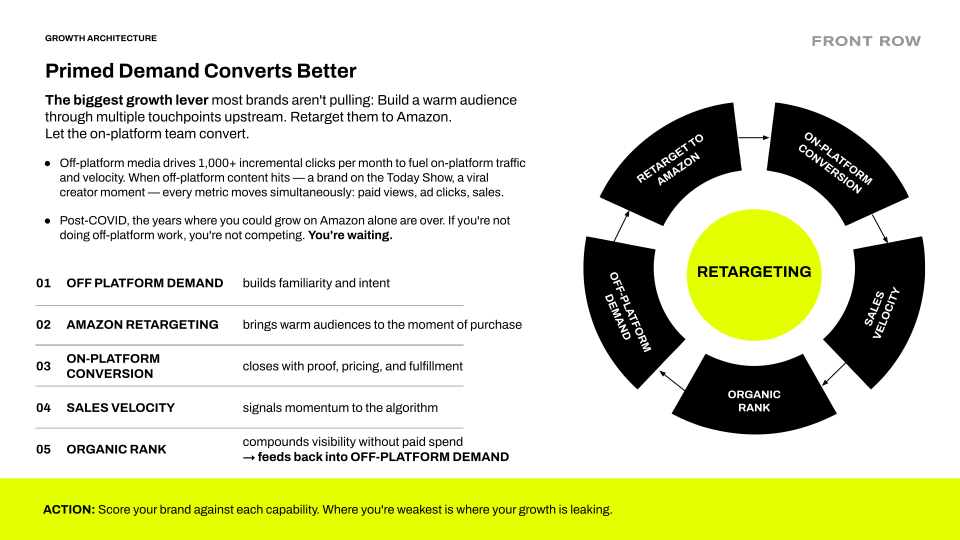
The consumer, Skinner argued, is no longer moving through a funnel. What exists instead is something closer to a ball of yarn, discovery happening everywhere, validation looping back through multiple touchpoints, purchase occurring where trust finally crystallizes. For most consumers in beauty and wellness, that place is Amazon. But the journey that leads there starts somewhere else entirely.
If you have a consumer hopping channels, those moments of handoff between teams are moments of leakage. If you don't have that team working in concert, you are leaking from that connected journey.

The failure pattern Skinner described is consistent across the brands Front Row works with. Brands have built channel-specific teams with channel-specific briefs and channel-specific metrics, then wondered why growth stalls when the consumer moves between them.
Front Row's data makes the cost of that misalignment visible. Brands running connected commerce systems, where off-platform demand feeds on-platform conversion, where content functions as proof infrastructure rather than creative output, where SEO, creator ecosystems, and marketplace execution operate as a single compounding system, grew at nearly 2x the Amazon category average across every vertical in 2025.
The brands that aren't doing this, Skinner said, are paying to play. Overspending, underdelivering, or worse: stalling inside a market that is growing at 5% annually and has $700 million median enterprise values waiting for the assets that are built to last.
The market is there. The buyers are there. The question the opening session left hanging in the room was the same one the rest of the afternoon was built to answer: why are so many brands still leaving it on the table?